
Towards a Bipartisan Energy Consensus
 Friday, February 27, 2026 at 2:16PM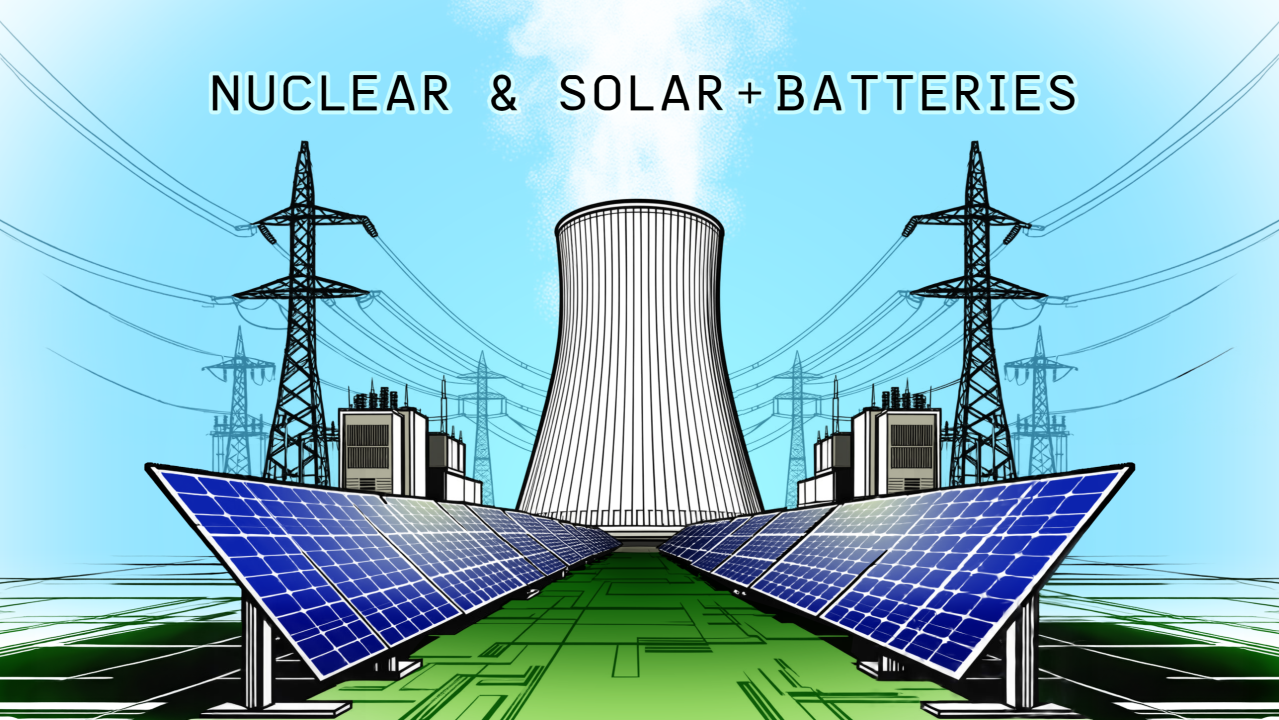
As the U.S. moves towards reindustrialization while simultaneously building out our national artificial intelligence infrastructure—energy policy has been moved to front-and-center.
Both nationally and globally we‘re living through a time of transition and tension and there is little that doesn’t get poisoned by the politic of the moment. Over the last two decades a partisan divide has grown that frames so-called “fossil fuels” and nuclear as Republican energy, and frames so-called “renewables” as Democrat energy.
The goal of this article is to reframe the energy debate.
Extreme partisans on both sides—with reinforcement from mainstream media narratives (FOX News, MSNBC, etc.)—insist on maintaining the aforementioned framing. However, reality does not reflect this—while support for solar may be higher among Democrats, a majority of Republicans also support solar; and while support for nuclear may be higher among Republicans, a majority of Democrats also support nuclear.
To the degree that Americans do support (or oppose) energy sources based upon political affiliation, this article aims to show how each side can craft better arguments that appeal to the values and sensitivities of the other.
Before we take a deep dive into the weeds, we will take a look at the data on partisan support for both, as well as noting some of the weaknesses in the data.
Historic support for nuclear has been driven by its ability to consistently produce exceptionally high base load energy output for decades, without the pollution of fossil fuels.
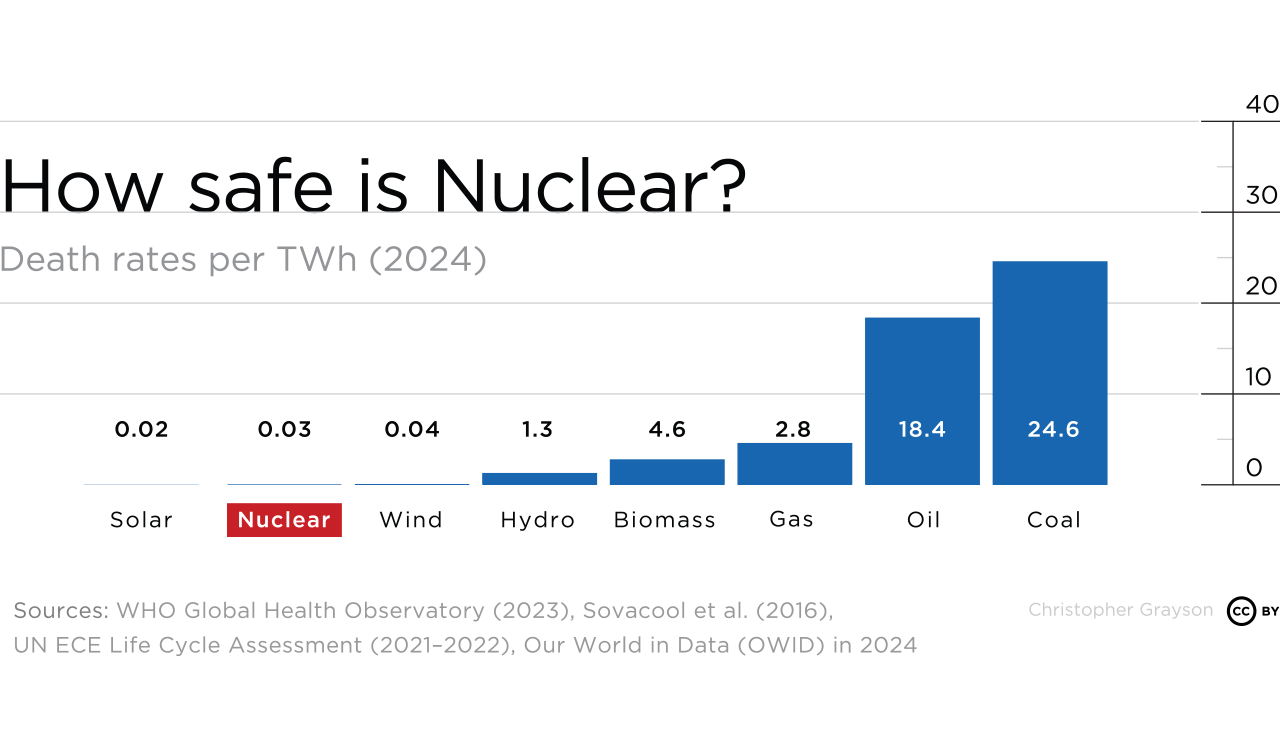
Across the partisan divide, opposition to nuclear has come from perceptions of its safety. There is a wide gap between those perceptions and reality. We will get into the data below.
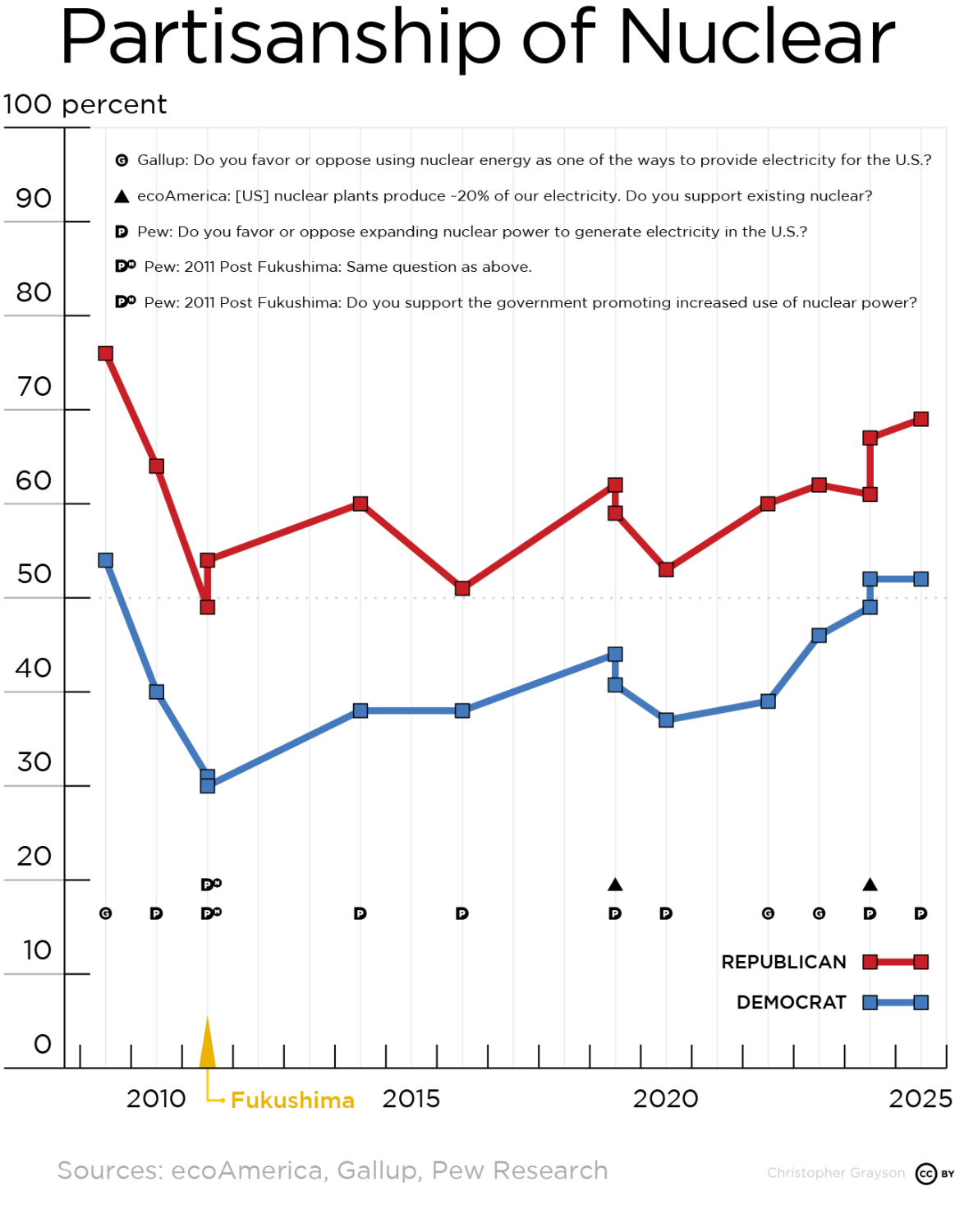
Our first chart shows the partisan divide on nuclear, tracked over time against four questions—similar, but different. Small changes in the wording of a question can have subtle, and even not-so-subtle changes in how people answer.
all charts & graphs are available via Creative Commons license, contact the author for vector files
We just went through a 16 year arc, where support for nuclear is roughly back where it started. In 2009 support for nuclear among Republicans was 76%, among Democrats 54%. Today support for nuclear among Republicans is 69%, among Democrats 52%.
The question is why did support for nuclear fall for so long? The answer is fear.
There is also a great deal of variability in how people answer based both on how they are asked, and how they are primed. Note that the 2019 & 2024 replies to the ecoAmerica question were primed by pointing out that America gets ~20% of its electricity from nuclear, then asks if people support nuclear. Apparently the notion of wiping out 20% of America’s electrical capacity caused both Democrats and Republicans alike to increase support for nuclear by 3%… at least when asked in 2019, compared to a similar question by Pew the same year (without priming). By 2024 this same priming only swayed Democrats by 3%, but caused Republicans to increase their support by 6% (again, compared to Pew’s results).
While this is interesting from a persuasion standpoint, it doesn’t answer the fundamental question: Are their fears of nuclear founded?
all charts & graphs are available via Creative Commons license, contact the author for vector files
Truth be told, nuclear is one of the safest forms of energy. We are going to address those unfounded fears below, but first we’re going to have a look at the partisan numbers on Solar.
all charts & graphs are available via Creative Commons license, contact the author for vector files
The largest nuclear reactor in our neighborhood is the Sun—solar energy is just nuclear energy at a distance.
While we saw above how Fukushima effected support for nuclear across the political divide in 2011, Republican support for renewables was impacted the same year due to the culmination of what they called “Climategate”—when, after protracted litigation, the University of Virginia begrudgingly agreed to release the underlying data from climate scientist Michael Mann’s “hockey stick graph.” If your goal is widespread adoption of solar, you need not convince them to adopt your worldview—nor do you need to adopt theirs—but it is useful to understand it, so you can make the arguments that appeal to their sensibilities, instead of the arguments that appeal to your own.
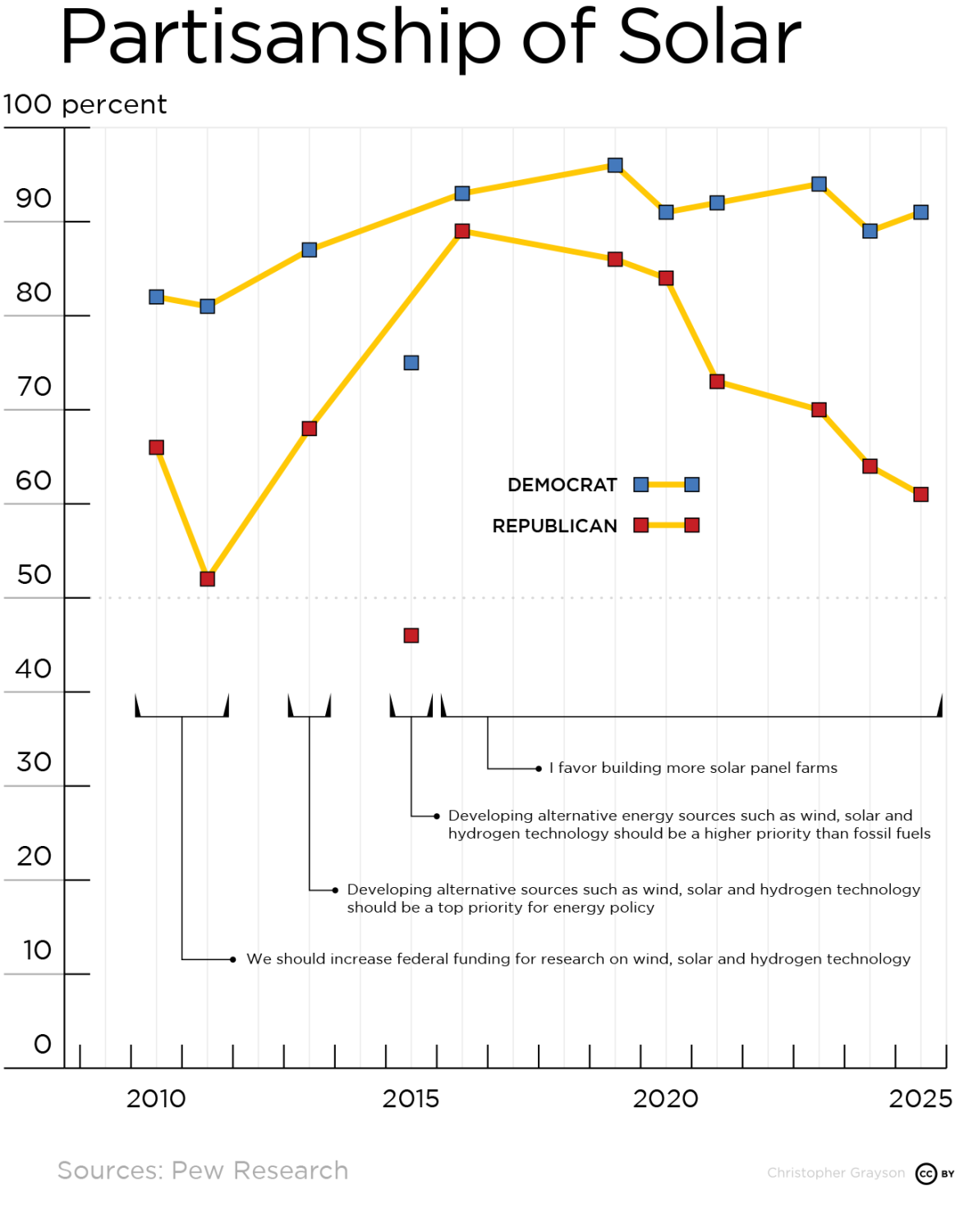
In spite of the hockey stick graph controversy, within five years Republican support for “alternative sources” of energy was at near parity with Democrats.
Also note that Pew did not collect separate data on solar until 2016. Prior to that, solar was lumped in with other “alternative sources” (spelled out as “wind, solar and hydrogen”)—what many Democrats are likely to call “green energy” and are now typically referred to in the industry as “renewables”. Only the questions from 2016 to 2025 asks specifically about “solar energy.”
There is another interesting anomaly in the solar data from 2015—rather than Pew’s typical inquiry about supporting “alternative energy sources,” in one year only, Pew added a modifier to the end asking if these alternative energy sources, ”…should be a higher priority than fossil fuels.“ That modifying statement not only collapsed Republican support for “alternative energy sources” by ~20%, it even dropped Democrat support by almost 15%. The qualifier distorted the graph so much that I bypassed those markers in the run line on the chart, but left the 2015 markers in place.
The most notable fact that both the nuclear and solar partisan support graphs reveal to us is that—beyond social media discourse and mainstream media sowing division— (a) a majority of partisans on both sides of the political divide support both solar and nuclear, and (b) that support for nuclear is fragile on both sides of the political divide, where safety concerns need to be better addressed.
With this understanding of partisan sentiments around solar and nuclear energy, we can now explore the most persuasive arguments across the isle, by presenting the case in their own terms.
How to Sell Solar to Republicans
When discussing energy, Democrats and Republicans talk past one another, because they argue from a position of differing priorities. As someone who strongly supports both nuclear and solar (plus batteries), I’m often engaging with either Republicans who then assume I’m a Democrat for supporting solar, or with Democrats who then assuming I’m a Republican for supporting nuclear.
My only goal is to (a) give Democrats better arguments to make the case for solar to Republicans, and (b) to give Republicans better arguments to make the case for nuclear to Democrats.
Party-base Democrat voters (white-collar, affluent urban / suburban) typically frame energy policy around ”climate crisis” arguments. Party-base Republican voters (blue-collar, working class, from suburban to rural) typically frame energy policy around a cost-benefit analysis—energy shocks are more likely to require them to reduce spending somewhere else in their household budget.
There was a time when solar was a weak energy source. At that time the cost benefit analysis argument was poor, but if one felt a higher-calling to do good by reducing CO² levels, the argument could be made that solar was still a good energy investment, “to address the climate crisis.” Hence, for decades, arguments for solar were framed in this manner.
Allegedly “weak solar” is no longer the case—but these arguments still dominate.
Here is a more persuasive case.
all charts & graphs are available via Creative Commons license, contact the author for vector files
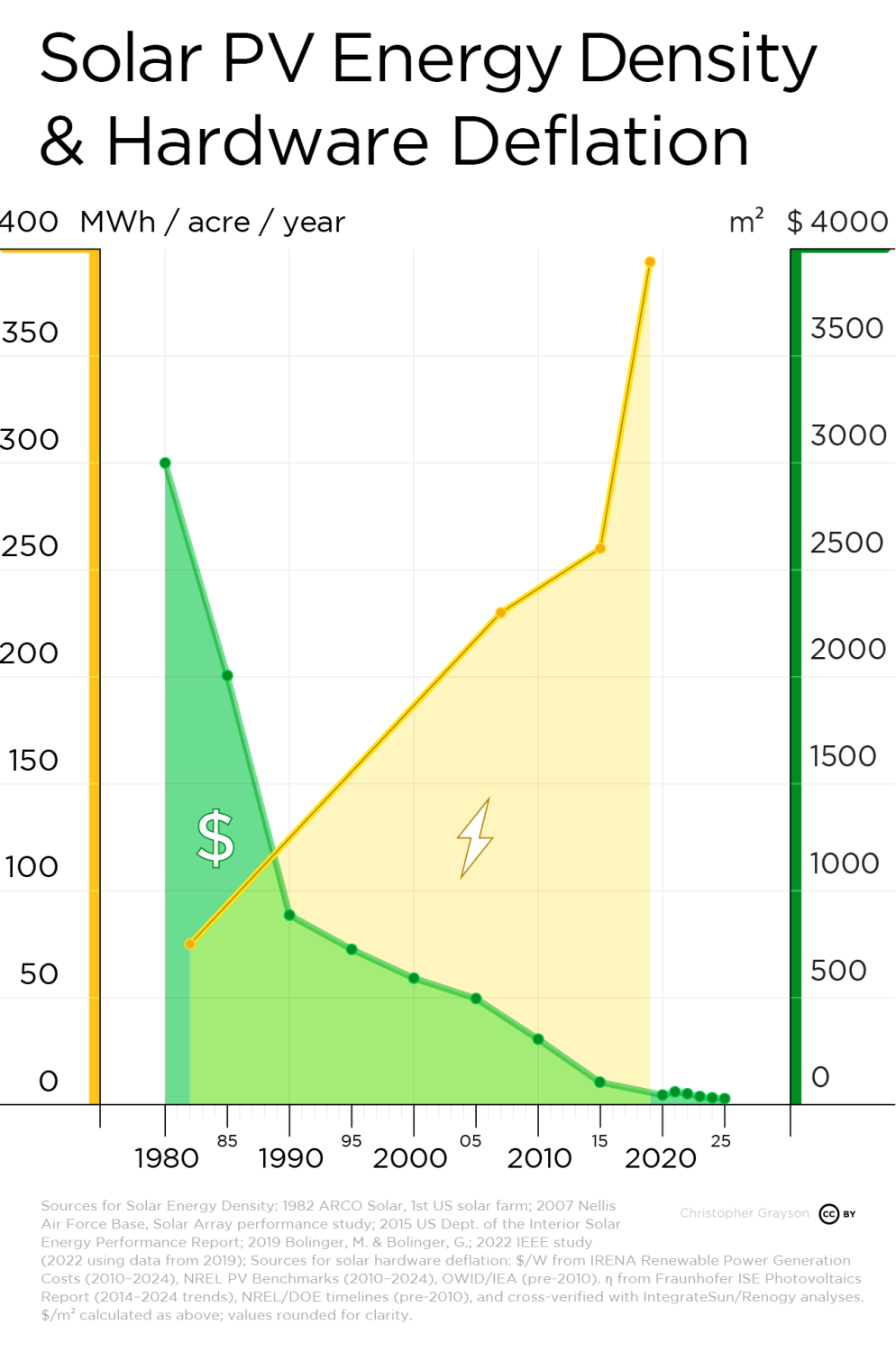
With a 425% increase in solar energy density (MWh/acre/year) from 1982 to 2019, that is not just a 4.63% annual compounding growth for 37 years, it is a growth rate that has been accelerating, now hitting an exponential rate of ~11% from 2015-2019.
Solar energy density has hit an inflection point such that it is now extremely price competitive with other sources—not just because the price of solar farms has gone down (though they have), but because the solar energy density has gone up—meaning a solar farm of the same size produces 425% more electricity.
Furthermore, moving into the future, this rate of grow in solar energy density is expected to continue for at least another 10 to 15 years… possibly more.
Solar has other advantages:
- Solar is modular: You can hot-swap older / poorer performing panels, with newer panels, or schedule cascading panel upgrades over time as energy density on newer panels continues to improve, without experiencing downtime.
- From proposal to operational, solar has the fastest development time of any power source. Some solar farms have delivered energy to the grid within six-months of approval. U.S. market average is less than 18 months (the government approval process averages ~50-70% of the project timeline).
When I engage with Republicans on the merits to solar, they typically view it as a weaker and more expensive energy source, that they feel Democrats support for ideological reasons—climate change / CO² levels. While these assumptions about solar may be wrong, Democrats rarely make the case for solar simply on the return on investment. In my anecdotal experience, this perception is more pronounced among older Republicans. If you wish to sell them on solar, don’t sell it as “Green,” show them the staggering energy density growth.
Solar is not wind, and should not be bundled as an energy category.
I also make a point of separating solar from wind. Why?
One of these energy sources uses the photovoltaic effect: When polysilicon is exposed to photons from sunlight, it energizes the electrons in the silicon atoms, causing them to break free from their bonds. The silicon is “doped” to create an internal electric field, forcing the freed electrons to flow directionally, and this produces direct current (DC) electricity. The other is a big fan blade that goes whirrrr.
While oversimplified, it’s an important distinction—generators used in wind turbines are a mature technology, and are fundamentally limited by the Betz Limit. Modern turbines already operate near this theoretical limit. So while solar energy density growth is exponential (at the same time that the cost of solar panels has plummeted), energy output growth produced year-over-year from wind turbines is linear at best, and when compared to solar is virtually flat. The selling point of solar—if you want to rally Republicans—is that completely regardless of CO² level, based on a pure cost-benefit analysis, solar is now extremely competitive with fossil fuels.
Wind turbines have no such corollary. Those on the Democratic side of the argument are accustomed to selling solar and wind as “Green Renewables,” hence they feel like they are an energy category, but when sold on the exponential growth of energy output, solar is in a league all of its own.
So if you’re a Democrat, and you wish to convince more Republicans of the merits of solar energy, those are some of the strongest arguments to make.
Because the Republican base is predominantly working class, there is another aspect to solar that enters their calculus, that is usually of less concern to most Democrats, and this relates to manufacturing. I’m going to circle back and address solar panel manufacturing separately at the conclusion to this article.
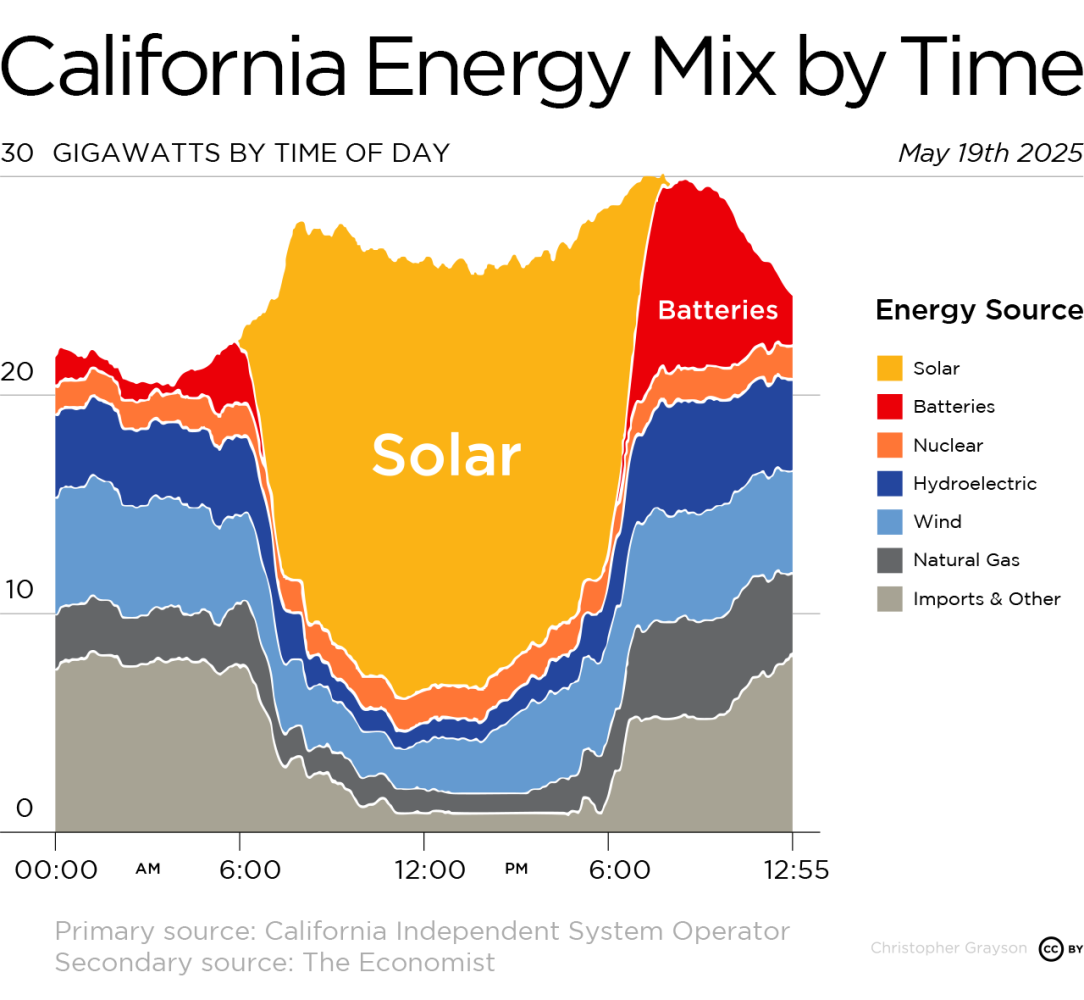
While we’ve made the case here for solar, solar’s spike in popularity is also partially due to its partner, batteries. Because solar cannot generate power at night, batteries store surplus electricity generated by solar panels during the day, saving energy that can be used at night. This is illustrated well by the graph below. As the sun comes up in the morning solar quickly eclipses all other power sources, and this is typical of any sun-shinny day. As the sun goes down in the evening, other energy sources ramp up, but the batteries charged with solar’s excess remain the largest source of power for the grid, for the next several hours.
Least anyone have their doubts, below is solar’s contribution to the California grid, on a Spring day. You can see how batteries extend solar’s contribution to California’s energy mix into the night and continuing into the morning, until the sun comes back up.
all charts & graphs are available via Creative Commons license, contact the author for vector files
Think California is leading in solar? Think again. As of this year, Texas, deep red Republican Texas—home of big trucks and big oil—has overtaken deep blue California as the leading American state in solar energy generation, Tell that to your proverbial “Republican uncle,” when he derides solar, over Christmas dinner.
Solar energy is the future.
Solar electricity will become by far the biggest source of power for civilization.
—Elon Musk
How to Persuade Democrats on the Merits of Nuclear

all charts & graphs are available via Creative Commons license, contact the author for vector files
Energy use peaks midday, and is highest in the summer heat. The beauty of solar is that it produces the most energy precisely at the moment when energy use is at its highest. But it does not produce energy at night, or in heavy cloud cover. Some of this is mitigated through the use of batteries, but even then other energy sources are needed for baseload. Most of those baseload energy options are fossil fuels, and have the highest CO² emissions…
…but not nuclear.
Nuclear delivers a consistent baseload, hours after hour, day after day, year after year.
The energy density of nuclear fuel is extremely high, so refueling is only required every 18 to 24 months. Nuclear reactors can operate at full capacity more than 90% of the time, higher than any other energy source, meaning they generate power almost continuously, and do so while producing no CO² emissions.
In Theory, That Should Be an Easy Sell
The operative sentiment being, “should be,” because most resistance to nuclear—from both Democrats and Republicans—is over safety concerns.
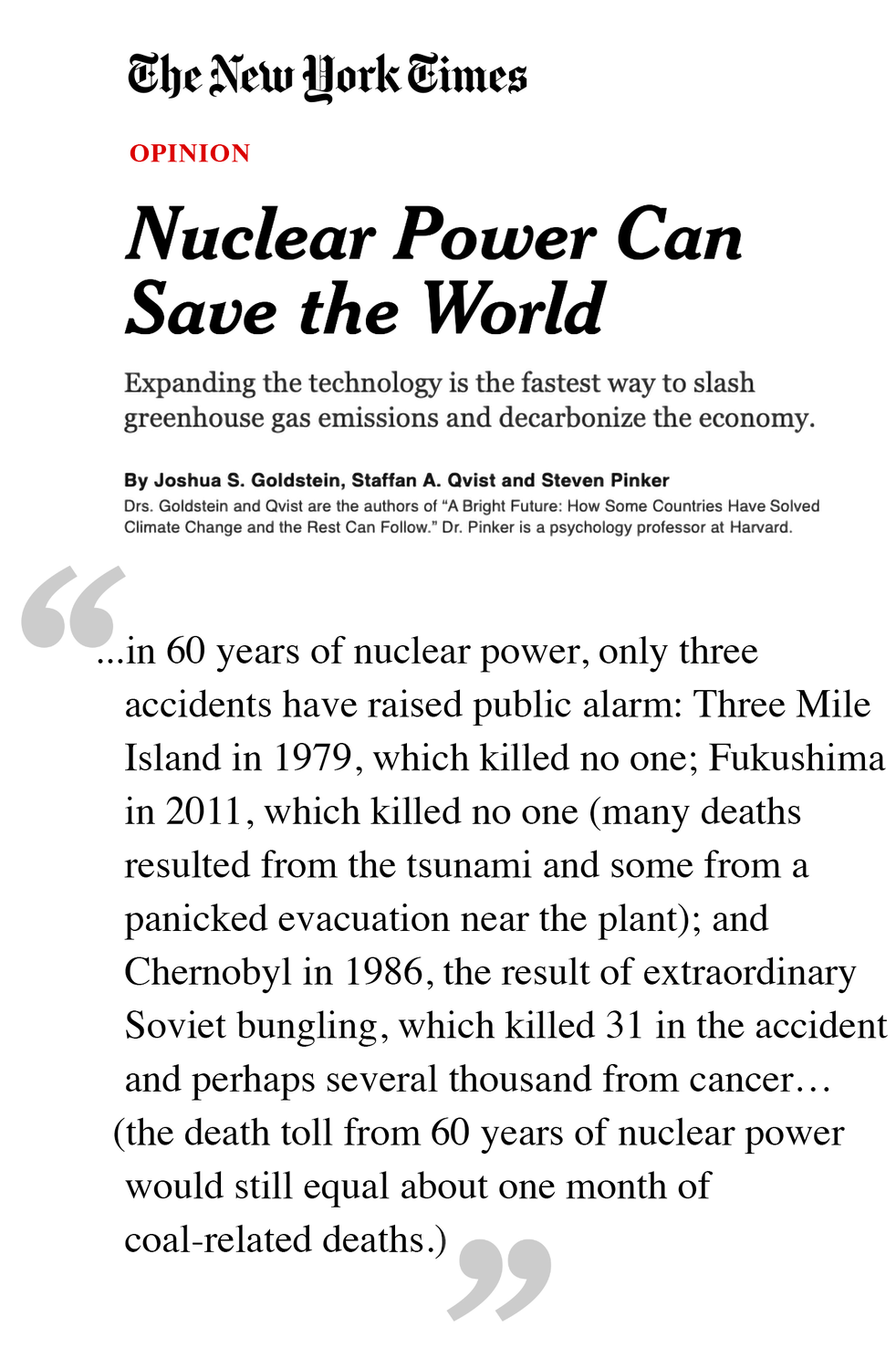
Towards the beginning of this article, I shared a chart on the safety record of nuclear energy, as compared to all other energy sources. Some people think visually, and I provide a lot of data here in charts and graphs, but others prefer the written word. There are many respected voices to choose from—I’m partial to Harvard psychology professor, Steven Pinker. He coauthored a New York Times Op-Ed on nuclear energy with University of Massachusetts, Amherst Political Science Professor, Dr. Joshua Goldstein and Swedish Nuclear Engineer, Dr. Staffan A. Qvist (Goldstein recently co-wrote the documentary, NUCLEAR NOW! with Oliver Stone).
Which Brings Me to the Inspiration for This Article
I recently published an Op-Ed in the Daily Memphian advocating for the completion of the already near-complete yet suspended Bellefonte nuclear plant in Jackson County, Alabama. Bellefonte is a two reactor, nuclear power plant. Unit 1 is said to be ~90% complete, but idle, and though it was successfully “hot tested” in 2007, with the intent of going online in 2011. It was once again postponed. There have been attempts by private sector investors to buy Bellefonte from the TVA and bring it online under new ownership, only to be scuttled in protracted litigation over the terms of the sale. Though the Op-Ed received high-traffic, and was quickly moved up to the featured editorial slot, it nonetheless received a somewhat hostile reception from the local commentariat in the replies—proffering conspiracies that I was on Elon Musk’s payroll, and other absurdities. Memphis is a pretty solid Democrat town, and many still view nuclear as a Republican energy source (ironic that my next proposed Op-Ed—should it be accepted for publication—will be on solar and batteries).
Which In-Turn, Brings Me Back to Solar and Manufacturing
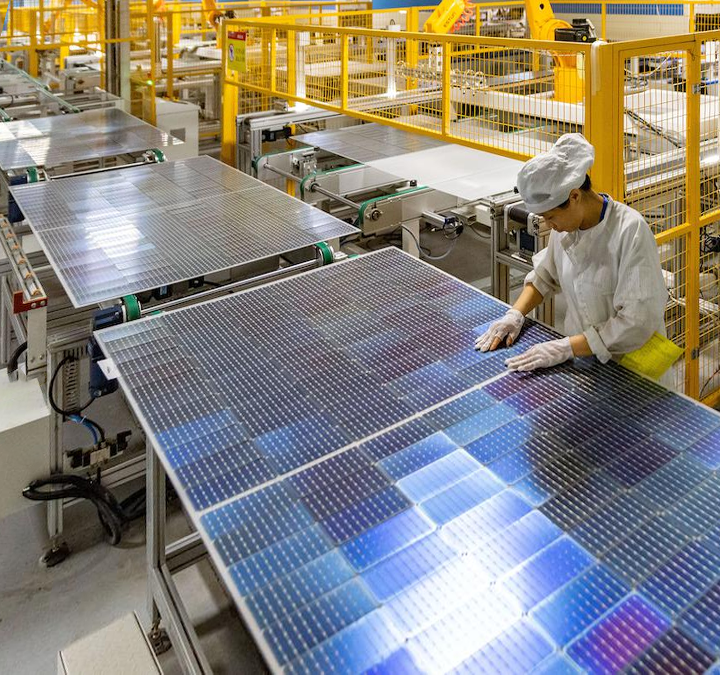
The other working class Republican talking point in opposition to solar is that solar panel manufacturing is dominated by Chinese manufacturers. In spite of being an American invention (Bell Labs), more than eighty percent of the global photovoltaic (PV) solar panel manufacturing is based in China. Working class Republicans don’t want U.S. domestic energy sources that employ American workers to lose market share to an energy source whose hardware—PV solar panels—is made overseas, and therefore costs American jobs.
all charts & graphs are available via Creative Commons license, contact the author for vector files
This is a completely legitimate concern, and the subject of my next aforementioned Op-Ed on why Memphis should be aggressively soliciting to bring solar panel manufacturing back to Memphis. As the former home to Sharp Electronics’ solar panel factory (2003-2014), Memphis was once a substantial player in the U.S.’ solar panel market. I will soon be making the business case for solar panel manufacturing’s return.
There should be no partisan divide over nuclear energy. There should be no partisan divide over solar energy. I will conclude with two charts comparing U.S. and Chinese energy output.
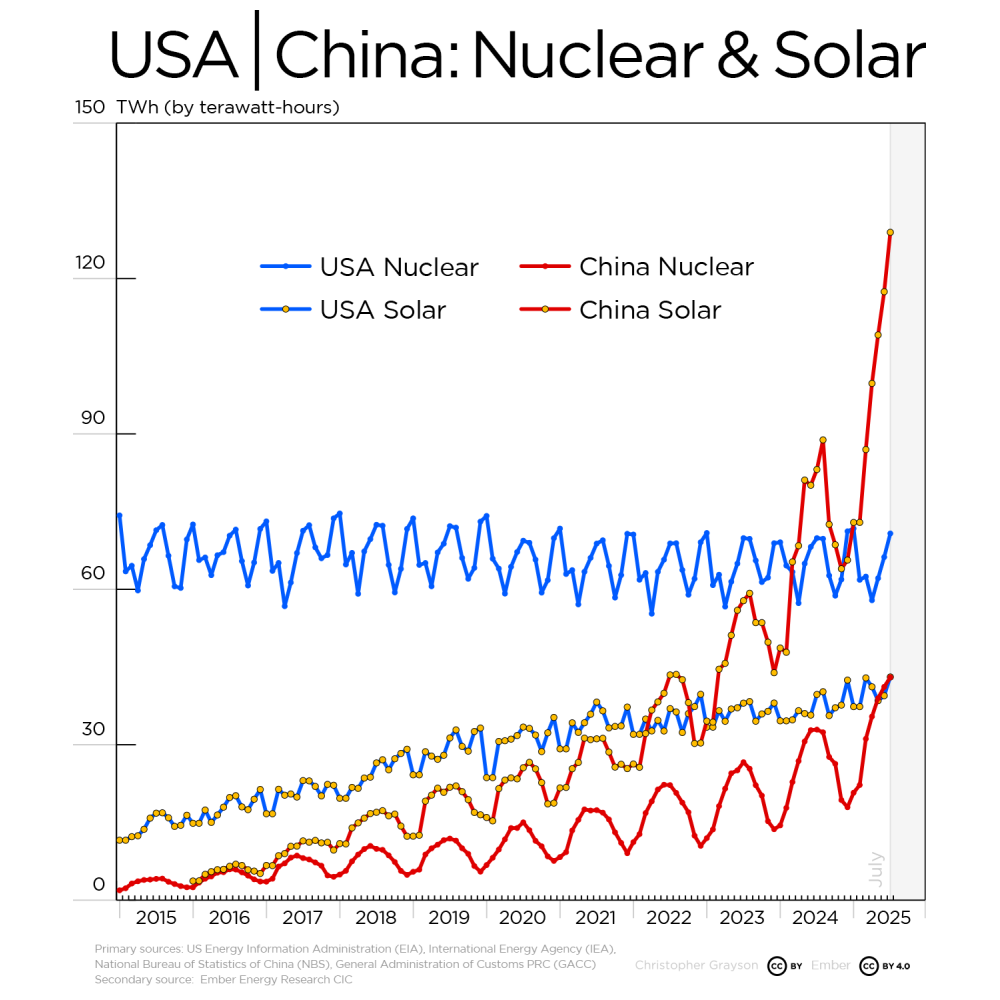
all charts & graphs are available via Creative Commons license, contact the author for vector files
However, while much to-do is made over China’s growth in both nuclear and solar, it should be pointed out that, as of China’s latest numbers, most of their electricity is still generated by coal. China is not so much a Mecca of low carbon energy, as a powerhouse of electric power generation, overall.
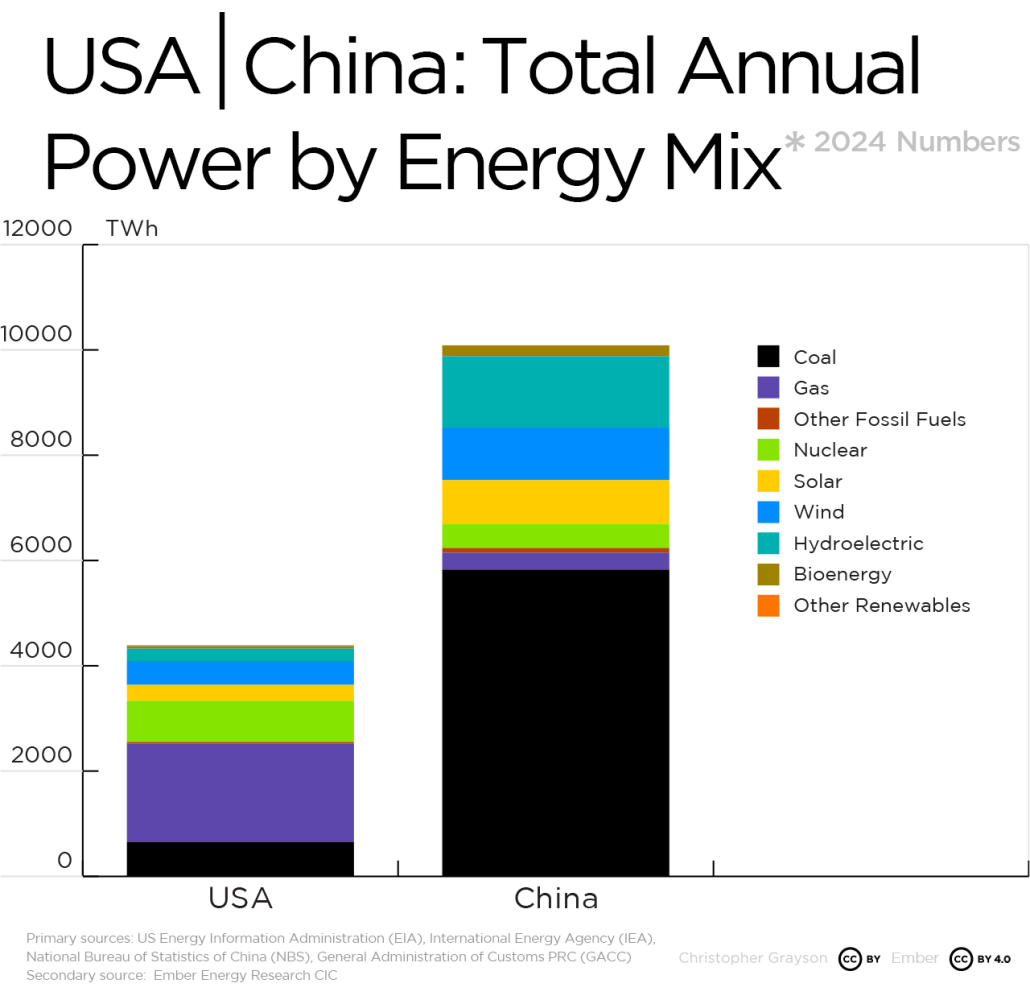
all charts & graphs are available via Creative Commons license, contact the author for vector files
If the U.S. is going to be competitive in this century, we need to rise above the politicization of non-political matters. Over the next decade—and going forward—the prosperity of a nation’s people, and their standard of living will largely be determined by their nation’s ability to produce affordable energy at scale.
Nuclear & Solar+Batteries is the way that we will get there.
Disclosure
Every act of persuasion is executed with a motive, and I want to be transparent about mine. As President of the AAIA Memphis Chapter I have the good fortune of living in Tennessee—both the birthplace of nuclear energy, and the US’ largest domestic producer of solar-grade polysilicon—all at a time when energy is the fundamental resource powering advanced AI, and Memphis is home to both the largest, and second largest AI superclusters. The AAIA (Applied Artificial Intelligence Association) is not in the infrastructure business, we represent those who use AI to solve specific, real-world problems in their own respective industries.
The AAIA empowers businesses to leverage AI through a global network of local chapters, connecting Memphis to larger markets, and industry resources for education, training, conferences and networking. The AAIA accelerates AI adoption by facilitating research, developing standards, and connecting organizations to drive innovation and growth.
The AAIA Memphis Chapter areas of focus include AI in Distribution including logistics, supply chain management, machine-vision fleet inspection systems, and logistics robotics; AI in Healthcare including medical research & drug discovery, medical device manufacturing, bioinformatics, and robotic surgery; Entertainment; as well as Agentic AI for Workforce Training & Assistance for manufacturing, maintenance, and the trades; and supporting the Memphis entrepreneurial tech startup community.
We also take a keen interest in the Tennessee energy market.
To learn more about our chapter, contact us here and I will answer your questions, and send you our Manifesto.

A regularly revised, living document on the Memphis economy, and where the AAIA adds value.